
2026-09-27 12:00:48
Choosing a coil winding machine is a specification problem. Choosing the company that builds it is a risk problem — and the risk is the one that costs you money. Most bad winding outcomes we get called in to fix are not machine faults; they are supplier faults: a machine that was quietly assembled from bought-in modules, a wire range that was quoted optimistically, a tension system that drifted after six months, or a spare part that took eleven weeks to arrive.
This guide sets out how to choose a coil winding machine manufacturer — the checks that separate a real factory from a reseller, and the questions worth asking before you commit a production line to one supplier. It is written for engineers and purchasing managers evaluating coil winding equipment for inductor, choke, transformer or motor coil production.
A large catalogue proves nothing. Many "manufacturers" list forty models and own a lathe and a warehouse. The distinction matters because a trading company cannot control tolerance, cannot modify a fixture to your core, and cannot supply a matched spare part three years later. The same test applies whether you are shortlisting coil winding manufacturers in China or motor winding machine manufacturers closer to home — the questions do not change, only the travel time does.
Four things to ask for, in this order:
| Check | What to Request | Red Flag |
|---|---|---|
| Machine assembly | Video walkthrough of the assembly bay, showing spindle, frame and control cabinet being built | Only finished machines in a showroom; no assembly area shown |
| In-house machining | Which parts are made in-house (frame, spindle housing, fixtures) vs. outsourced | "All parts are high quality" with no breakdown |
| Control system ownership | Who writes the motion program and the HMI — them, or a third party they buy from | Cannot explain the control architecture |
| Company registration | Business licence matching the factory address, plus export records | Address differs from the factory they claim |
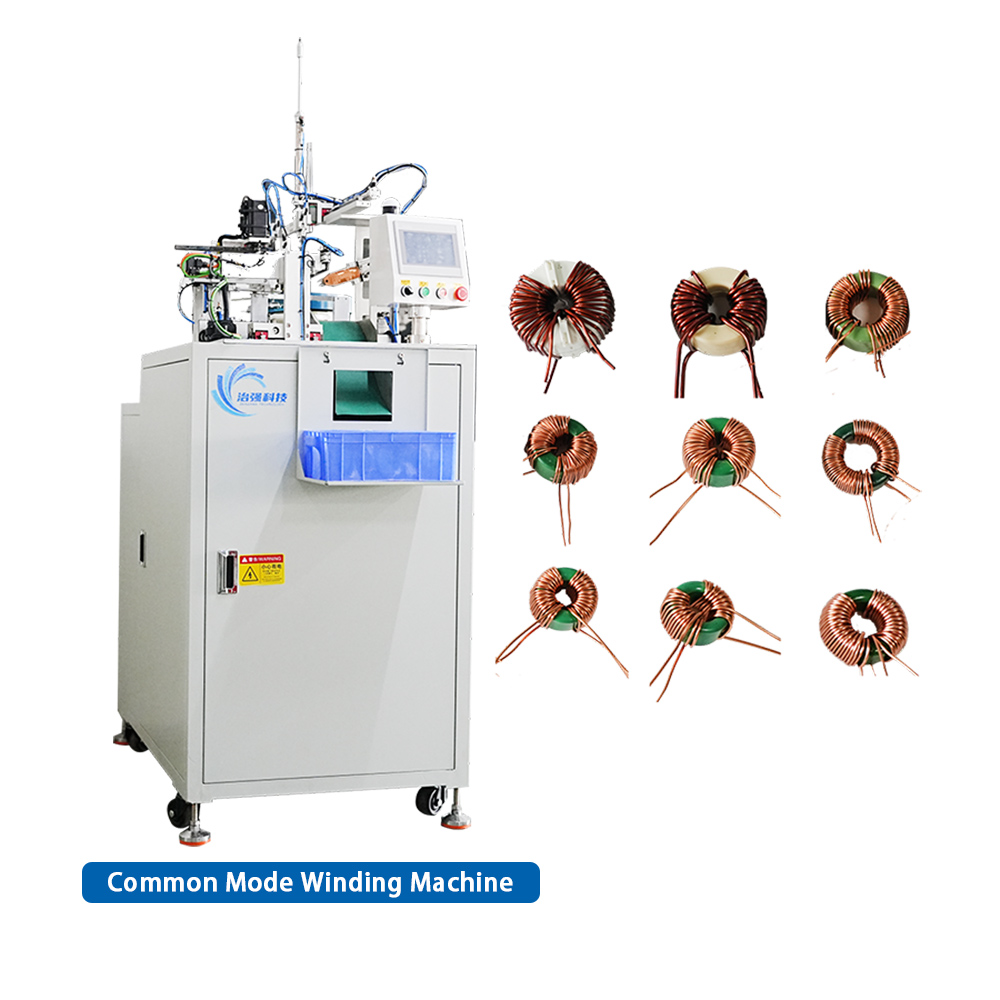
Evaluating a supplier right now? Send us your coil drawing and annual volume and we will tell you straight whether our common mode winding machine platform fits — or whether you need a different configuration. Contact our engineering team.
Once you know you are talking to a factory, the evaluation shifts to capability. Five parameters decide whether a supplier can hold your part, and every one of them should be answered with a number, not an adjective.
Ask for the exact minimum and maximum wire diameter the machine is calibrated for, in millimetres. A machine built for 0.1–2.5 mm will not hold tolerance on 0.05 mm magnet wire without different guides and tension hardware. Our inductor winding machine is specified for 0.1–2.5 mm, while the single station butterfly machine covers the fine end at 0.02–0.5 mm. The number matters more than the model name.
Precision claims need units. Our dual spindle platform is specified at ±0.05 mm positional precision — a figure you can verify by asking for a capability study across a 500-piece run rather than a single golden sample. Repeatability across a shift is what protects your yield; a good first article proves very little.
Spindle RPM is the most abused number in the industry, because it says nothing about turns per hour once acceleration, index time and loading are included. Ask for cycle time on a coil close to yours. Platforms running up to 1200 RPM are common on dual-spindle designs; what you need is the seconds per finished piece.
Give the supplier your worst-case core — smallest inner diameter, largest outer diameter, most fragile material. Nanocrystalline and thin ferrite cores crack under rigid clamping, so ask specifically how the fixture applies force. A supplier who cannot describe a cushioned or pneumatically compliant fixture has probably never wound a fragile core.
If you run high-mix production, tooling changeover is where your capacity disappears. Ask for the measured changeover time between two different coil models and whether recipes are stored on the HMI or re-entered by hand each time.
Two subsystems decide whether a machine is still producing good coils in year three: wire tension control and wire arrangement. They are also the two most commonly downgraded to hit a price point.
Closed-loop tension control adjusts as wire diameter, spool condition and winding speed change through the cycle. Open-loop or mechanical-damper tension does not — which is why coils from cheap machines show scattered inductance and visible layer irregularity by mid-batch. Ask whether tension is measured and corrected in real time, and what the stated tolerance is as a percentage of set tension.
Wire arrangement determines whether the coil builds evenly or crosses over. On fine wire, a poorly controlled arrangement layer shows up as micro-cracks in the enamel and later as dielectric failure in the field. This is the failure mode that costs you a customer, not a scrap bin.
Send us a sample coil. We will run it on the relevant platform and return the winding program, cycle time and tension settings — no charge. Request a trial winding analysis.
Custom coil winding is the point at which supplier quality becomes visible. Any factory can ship a catalogue automatic coil winding machine; not every factory can modify one.
Test them with a real problem rather than a hypothetical one. Send a drawing with an awkward core geometry or a wire you have struggled with, and watch how they respond. A capable manufacturer will come back with specific questions about core material, turns per layer, termination method and expected cycle time. A reseller will come back with a price.
Useful signals that a supplier genuinely does custom work:
That last point is underrated. A supplier who says no to something is usually a supplier who understands the process. Our own dual spindle automatic winding machine exists precisely because standard single-spindle platforms could not hit the output some customers needed on common mode chokes — that gap was identified from customer trials, not from a product roadmap.
Ask what happens between final assembly and the crate. The answer tells you how much of your own incoming inspection you can drop.
| Stage | What Should Happen | Documentation to Ask For |
|---|---|---|
| Incoming parts | Dimensional check on spindles, guides, fixtures | Inspection record or supplier COC |
| Sub-assembly | Spindle run-out and tension calibration before integration | Calibration log with dates |
| Final assembly | Full functional run on a representative coil | Test report with actual measured values |
| Pre-shipment | Sample winding to agreed acceptance criteria, video recorded | Video plus signed acceptance sheet |
| Packing | Rust protection, shock indicators, documented spare kit | Packing list with spare part numbers |
Insist on a video of the acceptance winding. A machine can pass a bench test in a factory and still arrive with a drifted tension controller after three weeks at sea. The video gives you a baseline to compare against on arrival.
Downtime cost usually exceeds the price difference between two suppliers. Before you sign, get four commitments in writing:
A supplier who cannot name their own wear parts is a supplier you will be chasing in eighteen months. Ask for the list as a document — if it takes a week to produce, that itself is the answer.
Treat this as a coil winding machine supplier evaluation checklist. A strong candidate answers most of these in the first meeting; a weak one deflects to price.
| # | Question | Why It Matters |
|---|---|---|
| 1 | Which parts of the machine do you manufacture yourself? | Separates factory from reseller |
| 2 | What wire diameter range can you hold tolerance on? | Defines real scope of supply |
| 3 | What is your measured positional precision, and can I see a capability study? | Turns a claim into evidence |
| 4 | Is tension closed-loop, and what is the tolerance? | Predicts year-three quality |
| 5 | Can you wind my worst-case core, and how do you protect it? | Reveals fixture competence |
| 6 | What is the changeover time between two coil models? | Determines high-mix viability |
| 7 | Will you run a trial winding on my sample before I order? | Cheapest risk reduction available |
| 8 | What testing happens before shipment, and can I get the video? | Gives you an arrival baseline |
| 9 | Can I have the wear-parts list with part numbers? | Tests long-term support |
| 10 | What is the lead time for critical spares? | Your downtime exposure |
| 11 | What is your warranty per component, and what voids it? | Prevents disputes later |
| 12 | Which coil types would you decline as out of scope? | Honesty signals competence |
If you are also benchmarking machine types before approaching suppliers, our guide to choosing the right winding machine for coil and wire applications covers the platform-level trade-offs.
On a representative inductor coil, a single-station platform produces roughly 55 pieces per hour. A dual-station machine such as the dual spindle automatic winding machine runs at approximately 110 pieces per hour, because it winds two coils per cycle. Real output depends on turns, wire gauge, core loading method and operator handling time — so treat these as planning figures and confirm them against your own coil during a trial winding.
Standard lead time is around 15 days. That assumes a configuration we already build. Larger quantities, new fixture designs, or machines that need a trial winding round before release will take longer. We confirm the schedule on the quotation so there is no ambiguity once the order is placed.
Our machines are running in Brazil, India, the Philippines, Singapore, Iran, South Korea and Pakistan, alongside domestic Chinese production. Export experience matters in this category because it forces a supplier to handle voltage variants, documentation, packing for long sea freight and remote commissioning support — all of which are easier to judge from a track record than from a brochure.
The right coil winding machine manufacturer is the one that answers technical questions with numbers and shows you the process instead of the brochure. Verify that they build the machine, confirm the wire range and tolerance against your actual part, test their fixture competence with your worst-case core, and lock down spares and service before you discuss price. Do those four things and the procurement decision becomes straightforward — and the machine you receive will still be producing good coils when the warranty has expired.
Ready to evaluate us the same way? Send your coil drawing, wire gauge and target output. We will reply with a recommended platform, a fixture approach and a trial winding proposal — usually within one working day. Talk to Chi Keung's engineering team.

Specialised in automated winding equipment and system development, production, sales and technical services as one of the high-tech enterprises.

+0769 82312151
+86 135 8090 8886
+86 132 6737 9998
3F, No.51 Minghua Road, Liangjia Village, Shijie Town, Dongguan City, Guangdong Province, China
Copyright © 2026 Dongguan Zhiqiang Electronic Technology Co., LTD | Privacy Policy | Terms and Conditions
