

2026-01-22 09:31:37
In the manufacturing of transformers, inductors, motors, and high-frequency electronic components, the toroidal Winding Machine plays a critical role. Compared with conventional linear winding methods, toroidal winding offers better magnetic performance, lower losses, and a more compact structure. This article explains how does a toroidal winding machine work, covering its operating principle, core structure, differences from other types of winding machines, and its industrial applications.
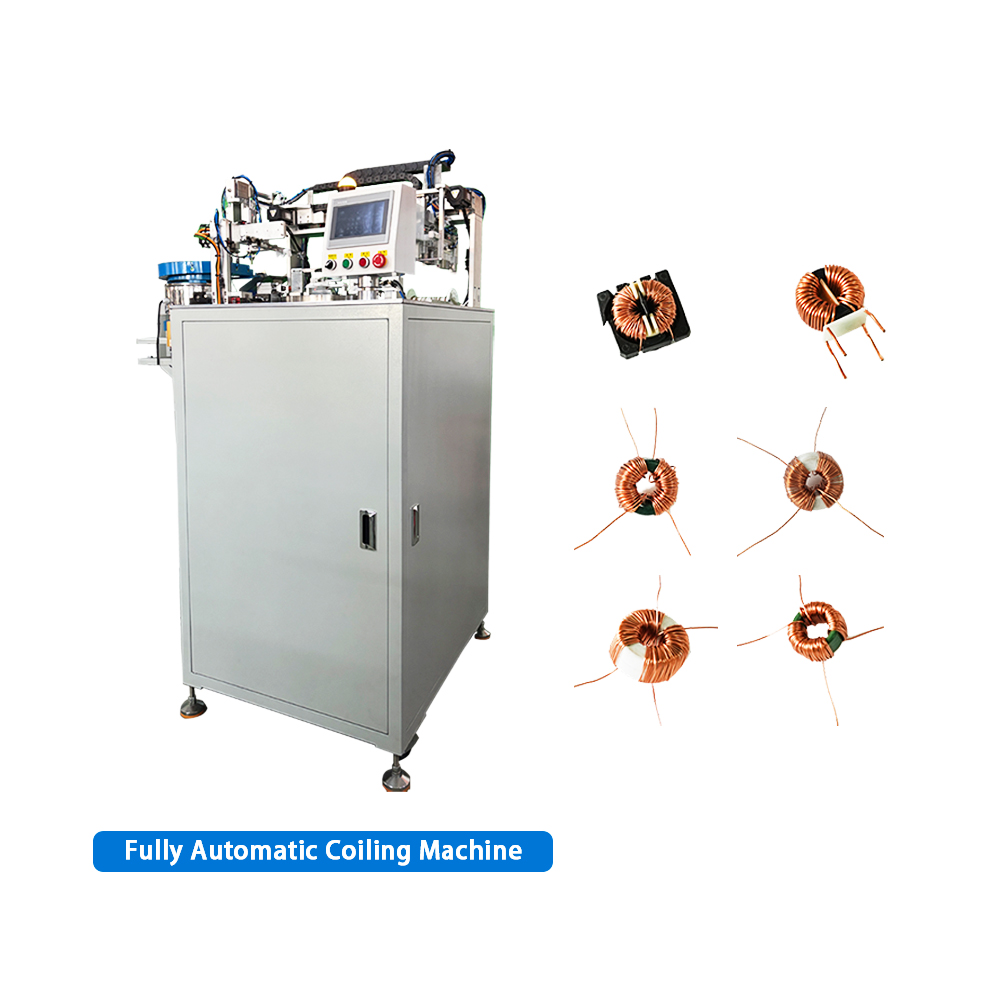
A toroidal winding machine is a specialized type of Coil Winding Machine designed to wind wire evenly and precisely around toroidal (ring-shaped) cores such as ferrite cores or powdered iron cores.
Unlike a traditional wire winding machine or spindle winding machine, toroidal winding must be performed on a closed magnetic core with no open ends. This requires extremely precise control of wire tension, winding path, and automation, making it a highly specialized form of Automatic Winding Machine.
The first step in toroidal winding is loading the wire into a rotating storage ring, commonly called a shuttle.
Instead of using a fixed spool like a conventional coil winder, the shuttle carries a pre-measured length of wire.
Copper wire is pre-loaded into the shuttle
The stored wire length determines how many turns can be wound in one cycle
This process is typical for a copper wire winding machine
The toroidal core is precisely clamped in a fixture:
Ensures the core is concentric with the winding path
Prevents displacement during high-speed operation
Essential for fully automatic coil winding machines
Accurate positioning directly affects winding quality and consistency.
Once the machine starts:
The shuttle rotates continuously around the toroidal core
Wire is guided onto the core turn by turn
Each full rotation of the shuttle completes one winding loop
This shuttle-based motion is the defining characteristic that differentiates a toroidal winding machine from a motor winding machine or ceiling fan winding machine, which typically wind around open slots or spindles.
Advanced Automatic Wire Winding Machines are equipped with:
Constant tension control systems
Precision wire-guiding mechanisms
Real-time monitoring of winding density
These features ensure uniform coil distribution, improving electrical performance and long-term reliability.
After the preset number of turns is reached:
The machine stops automatically
Wire is cut and leads are prepared
The core is ready for insulation or further processing
This fully automated cycle highlights the efficiency of an automatic winding machine in mass production.
| Machine Type | Characteristics | Typical Applications |
|---|---|---|
| Spindle winding machine | Fixed spindle, simple structure | Standard coils |
| Motor coil winding machine | Multi-slot, multi-phase winding | Motor stators |
| Ceiling fan winding machine | Large wire diameter, high power | Ceiling fan motors |
| Cable winding machine | Coils wire or cable into rolls | Cable packaging |
| Toroidal winding machine | Shuttle-based, closed-core winding | Toroidal transformers & inductors |
This comparison shows why toroidal winding machines are indispensable for high-performance magnetic components.
As manufacturing shifts toward automation, many producers adopt automatic winding machines or automatic cable winding machines:
High Consistency
Automation eliminates human error
High Productivity
Continuous, repeatable operation
Material Efficiency
Reduced copper loss and tighter windings
System Integration
Easily combined with taping, insulation, and testing modules
These benefits make toroidal winders ideal for advanced motor winding machines and power-supply production lines.
Audio equipment
Medical power supplies
Renewable energy systems
Used alongside motor coil winding machines
Servo motors and brushless motors
EMI filters
Noise suppression inductors
In some specialized fields, toroidal winding principles overlap with filament winder technology, where controlled tension and path accuracy are also critical.
Although the applications differ, both systems share similar mechanical and control concepts found in a filament winding machine.
Manufacturers often compare filament winding machine price when evaluating automated winding equipment investments.
Key factors to consider include:
Toroidal core size range
Wire material and diameter
Level of automation (semi-automatic or fully automatic)
Compatibility with existing wire winding machines
Technical support and after-sales service
For flexible production, a modular automatic coil winding machine is often the most practical solution.
Understanding how does a toroidal winding machine work comes down to mastering its unique shuttle-rotation mechanism, which winds wire continuously around a closed magnetic core. Compared with conventional coil winding machines, cable winding machines, or spindle winding machines, toroidal winders offer superior magnetic performance, material efficiency, and product consistency.
As electronic devices continue to demand higher efficiency, higher frequency operation, and compact designs, the toroidal winding machine, together with advanced automatic winding machines, will remain an essential part of modern precision manufacturing.

Specialised in automated winding equipment and system development, production, sales and technical services as one of the high-tech enterprises.
+0769 82312151
+86 135 8090 8886
+86 132 6737 9998
3F, No.51 Minghua Road, Liangjia Village, Shijie Town, Dongguan City, Guangdong Province, China

Copyright © 2026 Dongguan Zhiqiang Electronic Technology Co., LTD | Privacy Policy | Terms and Conditions